Somewhere on the climb to a high pasture above Theth — often on the Theth–Valbona crossing or a stage of the Peaks of the Balkans — a lot of hikers meet a large dog for the first time. It stands between you and a flock of sheep or goats, it is big, it may bark and move toward you, and there is no shepherd in sight. This is not a stray, and it is not quite the hazard people fear either. It is a working livestock-guardian dog, and how you behave in the next thirty seconds matters more than the dog's size. Here is what these dogs are, why they are on the trail, and the calm routine that gets you past them — set against the very different question of town strays and general safety in Theth.
Guardian dogs vs town strays: at a glance
| Livestock-guardian dog | Town stray | |
|---|---|---|
| Where | High pastures, on and above the trails | Around the village, guesthouses, car parks |
| Why it's there | Guarding a flock from wolves and bears | Scavenging, often semi-owned or fed by locals |
| Behaviour toward you | Territorial near the flock; barks, blocks, circles | Usually indifferent or hopeful for food |
| What it wants | You to move away from its animals | Nothing, or a scrap |
| Your job | Slow down, detour around the flock, don't engage | Normal caution; don't feed or corner them |
The short version: the guardian dog on the pass is doing a job, not hunting you. It almost always backs off once you and your walking party are clearly past its flock. The town dogs around Theth are a separate, milder matter.
Why the dogs are on the trail at all
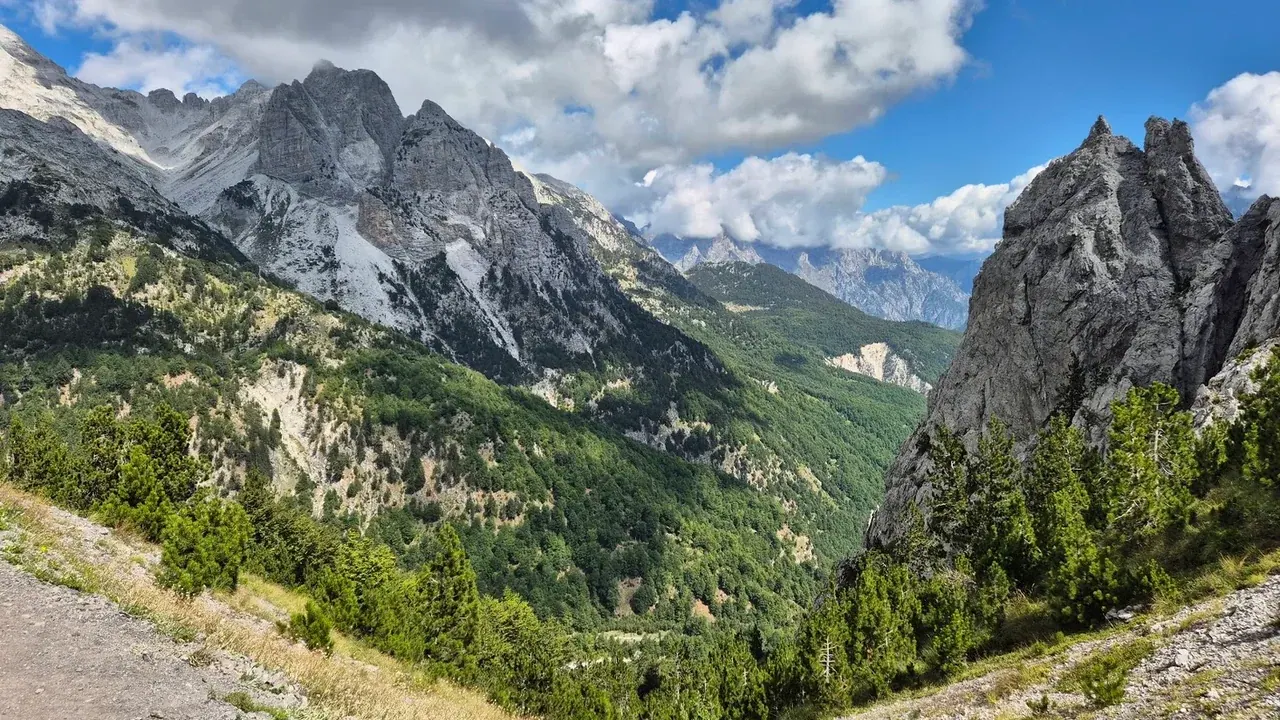
The Albanian Alps are still working shepherd country. In summer, families drive sheep and goats up to high pastures — the same alpine meadows the Theth–Valbona hike and other top Theth trails cross — and the flocks are guarded around the clock against wolves and bears, which are both present in these mountains. The dogs are the guard.
These are big, thick-coated livestock-guardian breeds, raised from puppies to live with the flock rather than with people. That upbringing is the whole point: the dog bonds to its sheep and treats anything approaching them — you, your poles, your dog — as a potential threat to be assessed and, if necessary, driven off. It is not aggression for its own sake. The dog's job is to dissuade, not to attack, and its default tools are noise, body-blocking and circling, not biting. Most encounters end with the dog satisfied that you are leaving and trotting back to its animals.
They are most active exactly when you are: through the summer grazing season, and especially in the early morning and evening when flocks are moving between pasture and fold. A dog resting in the shade at midday can be up and barking the moment you crest the rise into its meadow.
How to react: the calm routine
The instinct to run, shout or wave a stick is exactly wrong. Guardian dogs read a fleeing figure as prey and a raised stick or thrown stone as an attack — either escalates a stand-off you would otherwise have walked out of. The advice that mountain regions across the Alps give for these dogs is consistent, and it works here:
- Stop. Don't run. Halt calmly when the dog notices you. Let it see you are not rushing its flock. Running triggers a chase.
- Face the dog, but don't stare it down. Keep it in view and turn your body toward it, while avoiding hard, direct eye contact, which reads as a challenge.
- Back away slowly and give the flock a wide berth. Detour around the sheep, never through them. Putting distance between yourself and the animals is the single thing the dog wants — it usually settles as soon as you do it.
- Keep your pack or a trekking pole between you and the dog. Hold a pole low and passive as a barrier, not raised as a weapon. If you have a pack, let it be the thing nearest the dog.
- Speak calmly. A steady, low voice announces you as a person, not a predator. Shouting does the opposite.
- Do not approach the flock, the puppies, or the dog to photograph or pet it. This is the fastest way to turn a barking escort into a real problem.
- Let it escort you out. A dog that walks you to the edge of "its" territory, barking, is doing its job, not attacking. Keep moving steadily past, and it will peel off and return to the sheep.
If you are hiking with a dog of your own, keep it leashed and close — a loose pet dog near a flock is the scenario most likely to provoke a guardian into a genuine confrontation.
When they're most active, and when they retreat
Two patterns are worth carrying in your head. First, the dogs are tied to the flock, not the trail — the danger is not a fixed point on the map but wherever the sheep happen to be that week, which shifts through the season. A pass that was dog-free in June can host a flock in August. Second, the encounter is almost always brief. Guardian dogs defend a perimeter around their animals; once you are clearly outside it, the dog loses interest and goes back to work. If you feel penned in, the way out is not to push forward toward the flock but to widen your arc around it until the dog relaxes.
Because signal is unreliable on the high passes — see our note on phone coverage in Theth — you should already be walking with offline maps, water and layers. A guardian-dog stand-off that makes you leave the marked path to detour is a good reason to have those in your pack.
And the town dogs?
The dogs you meet around the village itself are a different, gentler story, and they belong to the wider picture of how safe Theth is. Albania has a population of free-roaming strays, and you will see a few dozing around guesthouses, the church car park and the trailheads. Most are indifferent, semi-owned, and fed by locals; they are far more likely to trail you hoping for food than to trouble you. Ordinary sense covers it: don't feed them, don't corner or startle one, don't reach for a dog that is sleeping or eating, and give a nursing mother space. Rabies is very rare in Albania but not impossible, so if any dog does break the skin, clean the wound well and seek medical advice — remembering that the nearest hospital is hours away in Shkodër. That is the honest ceiling on the town-dog risk: low, manageable, and nothing like the flock-guarding dogs up on the passes.
A short pre-hike checklist
| Situation | Do this |
|---|---|
| You spot a flock ahead | Slow down, scan for dogs, plan a wide detour before you're close |
| A guardian dog approaches | Stop, don't run, face it without staring, back away from the flock |
| The dog barks and circles | Stay calm, keep moving steadily past; it's checking you, not attacking |
| You're carrying poles | Keep them low as a barrier — never raised or thrown |
| You have your own dog | Leash it and keep it close, well clear of the flock |
| A town stray follows you | Ignore it, don't feed it; it'll lose interest |
For the fuller safety picture — terrain, weather, cash and medical care — read is Theth safe, and pack accordingly with our Theth packing list.
Frequently Asked Questions
Are the sheepdogs in the Albanian Alps dangerous to hikers?
They are guarding dogs, not attackers. A livestock-guardian dog near its flock will bark, block and circle to make you leave, but its aim is to dissuade, not bite. Stay calm, detour around the flock, and it almost always backs off once you're clearly past its animals.
What should I do if a guardian dog approaches me on the trail?
Stop — don't run. Face the dog without staring it down, speak calmly, and back away slowly, giving the flock a wide berth. Keep a pole or your pack between you as a passive barrier, never raised. Once you're clearly away from the sheep, the dog usually returns to work.
Where and when am I most likely to meet them?
On the high summer pastures the trails cross — the Theth–Valbona crossing and Peaks of the Balkans stages — wherever flocks are grazing. They're most active in the summer season and around early morning and evening, when animals move between pasture and fold.
Are the dogs around Theth village a danger too?
Much less so. Town strays are usually indifferent, semi-owned and fed by locals, more likely to beg for food than trouble you. Don't feed or corner them, give sleeping or nursing dogs space, and clean any bite well — rabies is rare in Albania but the nearest hospital is hours away.
Should I carry a stick to fend off the dogs?
Not to fend them off. A raised stick or thrown stone reads as an attack and escalates a stand-off. A trekking pole held low as a barrier is fine, but the real tools are stopping, staying calm, and detouring around the flock — which resolves nearly every encounter without any confrontation.