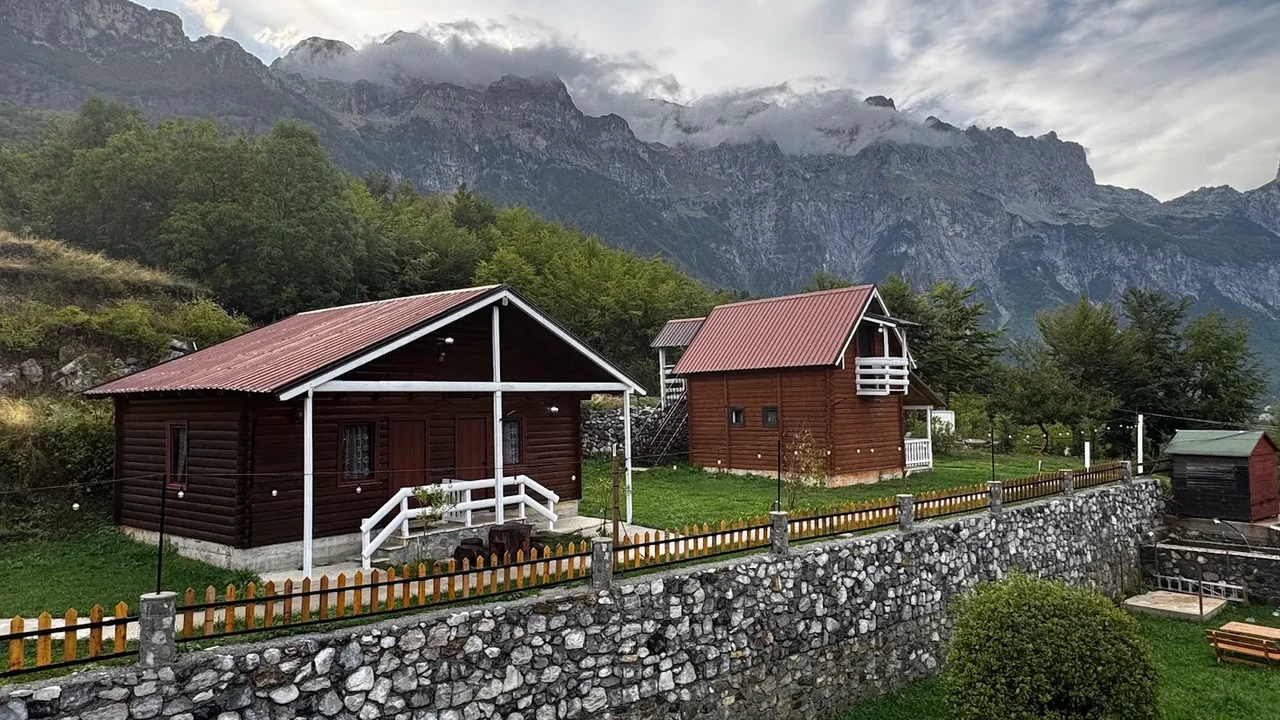
Most people eat almost every meal in Theth at their guesthouse, and most book half-board — bed, breakfast and dinner — because there are only a couple of standalone restaurants and your host cooks better anyway. What lands on the table is highland home cooking: layered fli, spit-roasted meat, cheese and yoghurt made a few metres away, garden vegetables, mountain honey, river trout and a shot of rakia to finish. This is the food of the valley as the valley actually eats it.
If you want the restaurant angle instead — the handful of places you can walk into without a booking — see where to eat in Theth. This guide is about the guesthouse table.
Guesthouse meals at a glance
| Detail | |
|---|---|
| Typical setup | Half-board: breakfast + dinner included in your room rate |
| Half-board cost | |
| Dinner style | Home-cooked, multi-dish, served family-style at a set time |
| Packed lunch | Usually available for a small extra charge — ask the night before |
| Dietary needs | Vegetarian easily managed; flag it when you book |
| Payment | Cash in lek — there are no ATMs in Theth |
The short version: book half-board, tell your host if you are hiking so they pack you a lunch, and carry enough lek for your whole stay drawn in Shkodër or Tirana — card payment in the valley is limited to non-existent.
What half-board actually costs
Guesthouse rates in Theth generally run 2,000–3,500 lek (€20–35) per person per night for a room with half-board, depending on the guesthouse, the room and the season — the two meals are the reason the figure sits above a bare bed. It is genuinely good value: a large home-cooked dinner that would be a proper restaurant meal elsewhere is folded into the price.
Two things to remember on money. First, a small municipal accommodation tax (roughly 35–350 lek per person per night) is usually collected in cash by your host and is not part of the price you booked online. Second, and most important: there are no ATMs in Theth. Draw all the cash you will need in lek before you come up the mountain — accommodation, meals, drinks, guides and the ride out. Our budget and cash guide has sensible totals to withdraw.
The dishes you will actually meet
Highland cooking is built on what the mountains give — dairy, meat, garden vegetables, foraged and home-grown staples — and cooked simply. Here is what tends to appear.
| Dish | What it is |
|---|---|
| Fli (flija) | The signature. Thin batter layers brushed with cream/butter and baked in a bell-shaped iron dome (saç) under hot coals — hours of work, served with honey, sour cream or cheese |
| Mish në hell | Meat (often lamb or kid) skewered and spit-roasted slowly over an open fire — a celebration centrepiece |
| Fresh dairy | Home-made cheese, yoghurt, sour cream and butter from the family's own animals; often the first thing on the table |
| Byrek | Flaky filo pastry filled with cheese, spinach or wild greens |
| Trout | River trout, pan-fried simply, when available |
| Kaçamak | A cornmeal porridge/polenta, often served with butter and cheese stirred through |
| Pite/vegetables | Garden tomatoes, cucumbers, peppers and beans — grown a few steps from the kitchen |
| Mountain honey | Local honey, for breakfast and to finish fli |
| Rakia | Home-distilled fruit brandy — the standard welcome and after-dinner drink |
Fli: the dish worth understanding
Fli (also written flija) is the one to know. It is made by ladling a thin flour-water batter in overlapping strokes onto a round pan, brushing each layer with a cream or butter mixture, and baking layer upon layer under a saç — the coal-topped iron dome that is the workhorse of highland kitchens. Building it up takes two to three hours, which is why it is a dish of hospitality and celebration rather than a quick supper. It arrives dense, rich and faintly smoky, cut into wedges and eaten with honey, sour cream or fresh cheese. If your guesthouse serves it, you are getting the real thing.
Mish në hell and the fire
Mish në hell — "meat on the skewer" — is the other showpiece: a joint of lamb or kid threaded onto a spit and turned slowly over embers until the outside crisps and the inside stays soft. It is not everyday food; it appears for groups, celebrations or when a guesthouse lays on something special. If you are a party of several and want it, ask your host in advance — it takes hours and often a whole animal's worth of planning.
Breakfast and packed lunches
Breakfast is where the dairy shines: fresh cheese, yoghurt, butter, byrek, eggs, bread, honey, jam and seasonal fruit, with coffee or mountain tea. It is simple, generous and exactly what you want before a climb.
If you are heading out on a trail — the Blue Eye, Grunas Waterfall or the big Theth to Valbona crossing — most guesthouses will make you a packed lunch for a small extra charge: bread, cheese, boiled eggs, fruit, maybe cold pie. Ask the evening before, not on your way out the door, so they have time to prepare it.
Drinks, and a word on rakia
The default welcome is a small glass of rakia, the home-distilled fruit brandy every household seems to make. It is strong, it is offered warmly, and declining politely is completely fine — but accepting a little is part of the ritual of arrival. Beyond that, expect bottled water, soft drinks, Albanian beer and coffee. Tap water in the valley comes straight off the mountains and is generally cold and excellent, but if in doubt ask your host.
Practical tips for eating well in Theth
- Book half-board. With few restaurants, it is the sensible default and the best food in the valley.
- Eat at the set time. Dinner is usually served at one hour for the whole house — turn up when your host says.
- Flag dietary needs when you book. Vegetarians are well catered for (dairy, vegetables, byrek, beans); just give notice.
- Carry cash in lek. No ATMs, limited cards — this is the recurring rule of Theth. See where to stay for how meals fold into your booking.
- Pace the rakia. It is stronger than it looks, and you may be walking uphill in the morning.
For more on the valley's eating options and produce, browse our what to eat overview and the restaurants list.
Frequently Asked Questions
What food is served at Theth guesthouses?
Highland home cooking: layered fli baked under a coal dome, spit-roasted mish në hell, fresh cheese, yoghurt and butter, byrek pastry, garden vegetables, river trout, kaçamak, mountain honey and home-distilled rakia. Meals are multi-dish, served family-style at a set time, and use ingredients grown or made a few metres from the kitchen.
How much does half-board cost in Theth?
Expect roughly 2,000–3,500 lek (~€20–35) per person per night for a room with breakfast and dinner, depending on guesthouse and season. A small municipal tax (about 35–350 lek per person per night) is usually collected in cash by your host on top. There are no ATMs in Theth, so bring enough lek.
What is fli?
Fli (or flija) is the signature highland dish: thin batter layered and brushed with cream or butter, then baked under a saç, a bell-shaped iron dome topped with hot coals. It takes two to three hours to build up, comes out rich and faintly smoky, and is served with honey, sour cream or fresh cheese.
Can I get a packed lunch for hiking?
Yes. Most Theth guesthouses will prepare a packed lunch — bread, cheese, boiled eggs, fruit, sometimes cold pie — for a small extra charge in lek. Ask your host the evening before rather than on the morning you leave, so they have time to make it up before you set off on the trail.
Is there vegetarian food in Theth?
Easily. Highland cooking leans heavily on dairy, vegetables and pastry: fresh cheese, yoghurt, byrek, beans, garden tomatoes and peppers, kaçamak and honey are all vegetarian. Flag it when you book so your host plans dinner accordingly, and you will eat very well without meat throughout your stay.